
Walk into an Indian kitchen today and you may find a bottle of cold pressed oil sitting beside the usual refined oil. What was once a niche product in health stores has become a regular purchase for families who want food closer to its source. But popularity brings problems: confusing labels, big promises printed on packs and, now and then, news about adulteration. In 2026, the rulebook for edible oil became stricter, and both shoppers and sellers of cold pressed oil need to understand how. This guide walks through the changes in simple English, explains which updates are already in force and which are still proposals, and gives practical checklists for buyers, retailers and small cold pressed oil brands, with local examples from Gujarat. Food regulations are revised from time to time, so please confirm the latest notification on the official FSSAI website before taking any business decision.
What Is Cold Pressed Oil, and Is Kachi Ghani Oil the Same Thing?
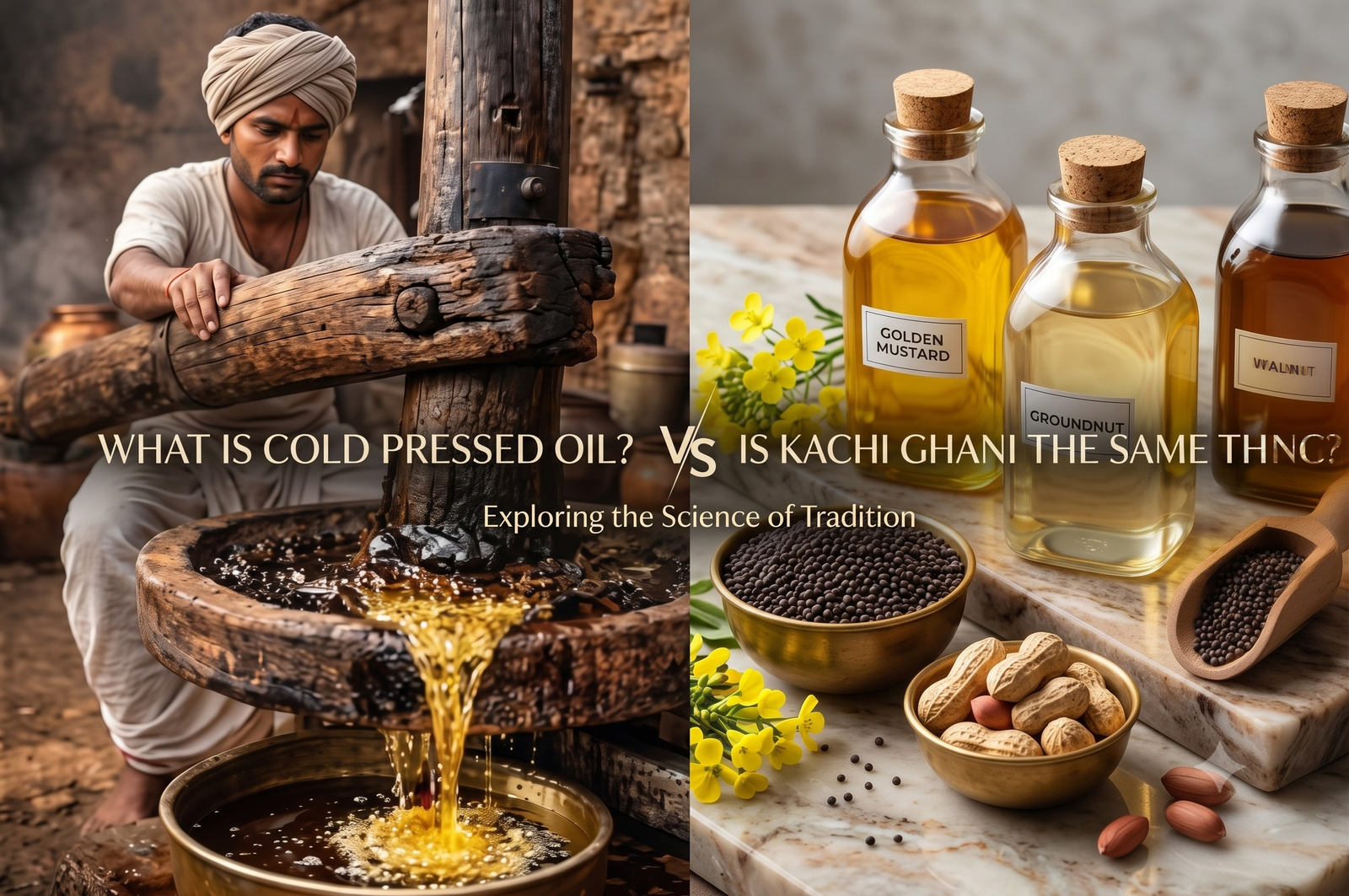
Cold pressed oil is oil squeezed out of seeds or nuts by a mechanical press at low temperature, with no chemical solvents and no heavy refining. Kachi ghani oil is the traditional Indian form of this method, best known in mustard oil. Shoppers use both words for minimally processed oil, though the label still needs to be honest.
The word “ghani” points to the old oil press that was once carved from wood or stone and driven by a bullock walking in circles. Today most producers use compact mechanical presses, but the principle is unchanged: crush the seed slowly, keep the heat low and collect what flows out. Refined oil follows a longer path. After extraction, it is usually degummed, bleached and deodorised so that it looks clear, smells neutral and lasts longer on the shelf. Cold pressed oil skips most of these steps, which is why it keeps the colour, aroma and slight cloudiness of the seed it came from.
Take Anveelifecare groundnut oil as an example . Anveelifecare is one of the best cold pressed oil in gujarat and all over the country and The cold pressed version smells like roasted peanuts and adds a warm flavour to sabzi and chutneys, while the refined version is almost odourless. People who love this taste often say they have found the best cold pressed oil for home cooking. The trade-off is practical: cold pressed oil costs more per litre and should be finished within a sensible time. If you want to go deeper, read our guide on kachi ghani oil and how this cold pressed oil tradition works.
What Are the New FSSAI Rules for Cold Pressed Oil in 2026?
An amendment notified in July 2025 took effect on 1 February 2026 and changed the accepted refractive index readings for several edible oils, a key purity check. Draft standards for a new group called minor seed oils also suggest that cold pressed oil in this group must be free of solvents and additives. That draft is not final law yet.
Refractive index is a lab reading that shows how strongly light bends as it passes through oil. Each oil has its own expected range, so a result outside that range can hint at blending with a cheaper oil. By revising these ranges, FSSAI gave laboratories and manufacturers fresh benchmarks, and producers had to recalibrate how they test their batches. Reports on the amendment name palm oil and palmolein among the oils affected.
The second development is a draft for what FSSAI calls minor seed oils: chilli seed, muskmelon seed, okra seed and tomato seed oil. According to the draft, cold pressed and virgin oils in this group should carry an acid value no higher than 4.0 mg KOH/g, whereas refined versions must stay under 0.6. The draft also keeps solvents and additives out of cold pressed oils, requires a negative test for argemone oil and sets limits for iron and copper.
Please note that a draft is a proposal open to comments, not a binding rule. It is still worth following because it shows the direction in which cold pressed oil regulation is moving.
Update | Status | Who should care |
Revised refractive index for several edible oils | In force from 1 Feb 2026 | Manufacturers, labs, retailers |
Minor seed oil standards (chilli, muskmelon, okra, tomato) | Draft proposal | Niche cold pressed oil brands |
“Kachi Ghani / Cold Pressed” label condition for mustard oil | Existing standard (verify current text) | Mustard oil sellers |
Can Any Oil Be Called “Kachi Ghani” or “Cold Pressed” Under FSSAI Standards?
No. For mustard oil, FSSAI’s standard permits the words Kachi Ghani or Cold Pressed only if the oil contains at least 0.20% natural allyl isothiocyanate by weight. That compound gives mustard its sharp bite, so regulators have a measurable test and a cold pressed oil label is more than a marketing phrase.
This matters for shoppers because it proves that a kachi ghani oil claim can be checked in a laboratory, at least for mustard. If a bottle labelled kachi ghani mustard oil tastes flat and has hardly any pungency, you have good reason to ask questions. This condition comes from an earlier FSSAI amendment, so check the current text of the standard before quoting it on your own labels.
The same standards treat cold pressed oils a little differently on oxidation too. They allow a peroxide value of up to 15 milliequivalents of active oxygen per kilogram for cold pressed and virgin oils, while refined oils are held to 10, with olive oil as the exception. Think of it this way: cold pressed oil is less processed, keeps more natural compounds and ages differently, so its limit is slightly more relaxed. Even so, a bitter taste or a smell like old paint tells you the oil has turned rancid, whatever a label says.
For groundnut, sesame, coconut and other cold pressed cooking oil types, no single marker as simple as mustard’s exists. That is exactly why batch-wise lab reports are valuable. A confident seller will share them easily, and a careful buyer will ask for them.
Cold Pressed Oil vs Refined Oil vs Expeller Pressed Oil: Quick Comparison
Cold pressed oil keeps more natural aroma and is extracted without chemical solvents. Refined oil is processed further to get a neutral taste and a longer shelf life. Expeller-pressed oil is also pressed mechanically but may involve more heat. The right pick depends on your cooking style, budget and storage habits.
Feature | Cold Pressed / Kachi Ghani | Expeller Pressed | Refined Oil |
Extraction | Low-heat mechanical press | Mechanical press, often higher heat | Often solvent extraction plus refining |
Chemical solvents | None in true cold pressed oil | None | Commonly used |
Aroma and taste | Strong, natural | Medium | Neutral |
Shelf life | Shorter | Medium | Longer |
Price | Higher | Medium | Lower |
Best for | Tadka, pickles, sautéing, raw use , Everyday cooking . | Everyday cooking | Deep frying, bulk cooking |
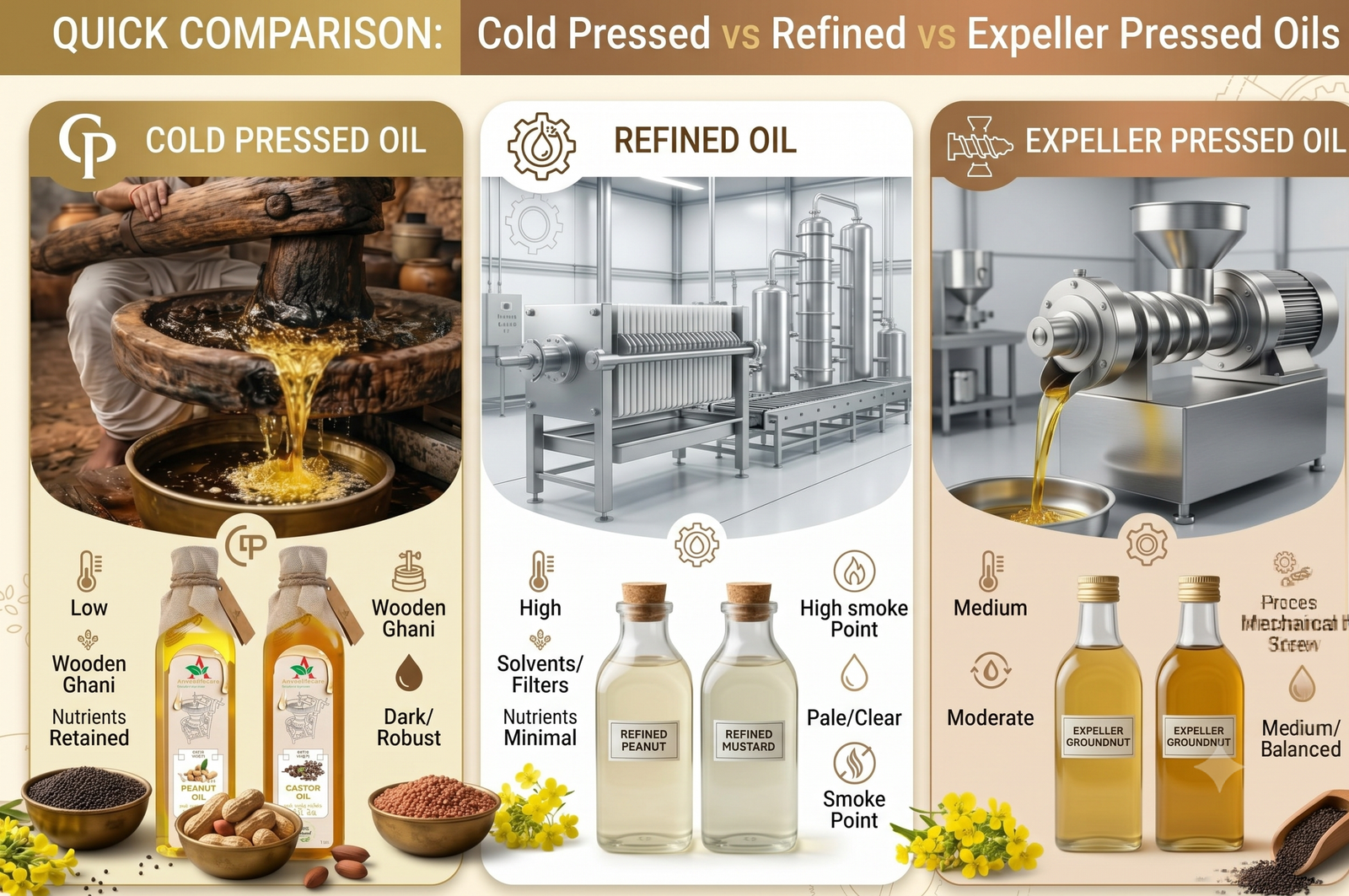
Many households mix and match. A family may use cold pressed oil, such as mustard or groundnut, for daily cooking and keep a small bottle of refined oil for festival frying. That is a perfectly reasonable approach, and nobody has to switch completely overnight. When you compare prices, remember that you are paying for slower extraction and lighter processing, not just for a fancy label.
How Should Buyers Choose the Best Cold Pressed Oil in India After the 2026 Changes?
Look for four things: a valid FSSAI licence number, a clear statement of the oil type and extraction method, batch and best-before dates, and a recent lab report if the seller can share one. Be wary of very cheap cold pressed oil, since true low-temperature pressing recovers less oil from every kilo of seed.
Use your senses along with the label. Fresh cold pressed oil smells like the seed it came from. A thin layer of natural sediment at the bottom is normal, but a sharp, bitter or paint-like smell points to rancidity. If you are trying a new brand, buy a one-litre bottle first and use it for a week before ordering a large tin.
Storage decides how long your cold pressed oil stays good. Keep it away from sunlight and the heat of the stove, close the lid after every use and never pour fresh oil on top of old oil.
Festival months need extra care. FSSAI runs special drives before big festivals to catch adulteration in high-demand foods, and edible oils and ghee are among the items that attract attention because demand and risk rise together.
Home tricks such as the freezer test or the drop-in-water test are not dependable. Only a laboratory can confirm purity, so prefer brands that publish proper reports. Following this routine will help you pick the best edible oil in India for your own family rather than the one with the loudest advertisement.
What Should Sellers and Small Oil Brands Do to Stay Compliant in 2026?
Sellers should hold the correct FSSAI licence or registration, test every batch against current oil standards, label the extraction method honestly, avoid unproven health claims and keep lab reports ready. Retesting after the 1 February 2026 refractive index changes protects both the cold pressed oil brand and its customers.
A practical compliance routine looks like this:
- Licence: Keep a valid FSSAI licence or registration that matches your turnover and business type, and print the number on every pack.
- Testing: Send samples from each batch to an FSSAI-notified or NABL-accredited lab for parameters such as refractive index, acid value and peroxide value.
- Labelling: Show the oil name, extraction method, net quantity, batch number, manufacturing date and best-before date clearly.
- Claims: Handle words like “natural” and “100% pure” with care. FSSAI has been looking closely at exaggerated “100% natural” style claims, so read the latest advertising and claims rules before printing new labels.
- Records: Maintain seed purchase bills, batch records and test reports so you are ready for any inspection.
Here is a simple example. A small unit in Gujarat pressing groundnut oil should test each batch before it reaches shelves, not just once a year. Buyers increasingly ask for proof, and brands that share reports usually win repeat customers faster. If you are planning to start your own unit, our training programs cover licensing, machines and costing.
Is Cold Pressed Cooking Oil the Best Oil for Cooking and Health?
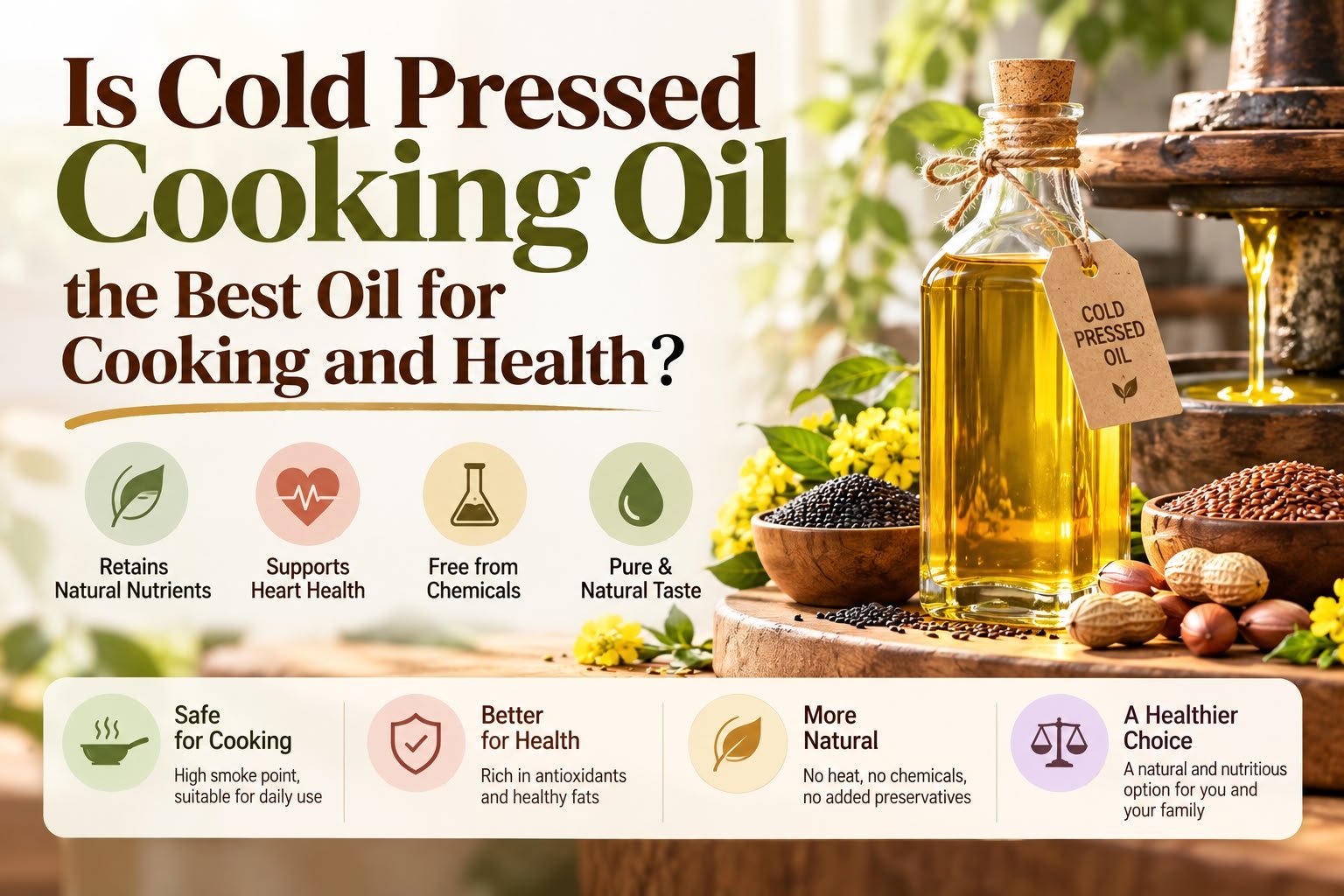
No single oil is best for everyone. Cold pressed oils are less processed and full of natural flavour, but your health depends on how much oil you eat, how you cook and what the rest of your diet looks like. A sensible habit is to keep cold pressed oil as one option in your kitchen, rotate oils and match each one to the cooking method.
Nutrition experts often point out that no one oil suits every person or every dish, and that common options like sunflower or rapeseed oil are perfectly acceptable for most people. So the best cooking oil for health is usually the one you use in moderate quantity, store properly and balance with other oils instead of relying on one product.
When choosing the best oil for cooking in an Indian kitchen, think about the dish. Cold pressed groundnut and mustard oils suit everyday sautéing and traditional recipes. Sesame oil is popular for tempering and in several regional cuisines. Because cold pressed oils retain more natural compounds, they can break down faster under very high or repeated heat, so for heavy deep frying many people prefer an oil built to handle it.
If you live with a condition such as heart disease or diabetes, speak to your doctor or dietitian about the type and amount of oil that suits you. Cold pressed cooking oil is a good choice for taste and minimal processing, but it is food, not medicine.
Organic Oil, Natural Oil and Chemical-Free Claims: What Can You Trust?
“Cold pressed” describes how oil is extracted, “organic” describes how the seeds were grown and certified, and “natural” is a loosely used word. A trustworthy organic oil shows a recognised organic certification mark with certificate details, while “chemical free” should be supported by test reports.In India, genuine organic oil usually carries recognised marks such as India Organic or the Jaivik Bharat logo used for organic foods. If a pack simply says “organic” with no certification details, ask the seller for proof. Certification also matters beyond India. Standards such as USDA Organic and EU Organic are becoming important for export markets and premium shelf space.
Be careful with the phrase “chemical free”. An oil pressed without solvents is not automatically free of pesticide residue, because that depends on how the seeds were farmed. Similarly, a natural oil can still be poor in quality if the seeds were old or badly stored.
A smart buyer reads the claims in three layers:
- Extraction method: cold pressed or kachi ghani
- Seed quality: organic certificate or a traceable farm source
- Safety: a batch-wise lab report
When all three are visible, the Anveelifecare cold pressed oil brand is far more credible than one that just prints “100% natural” in large letters.
Chemical Free Hair Oil and Oil for Skin: Do FSSAI Rules Apply?
Hair and skin oils are usually regulated as cosmetics rather than food, so FSSAI’s edible oil standards do not directly apply to them. Still, food-grade cold pressed oils such as coconut and sesame are widely used for hair and skin, and any product sold for cosmetic use should carry proper cosmetic labelling.
Interest in this area keeps growing. Cold pressed oils are finding more use in personal care for moisturising and scalp massage, which is why so many people search for chemical free hair oil and a gentle oil for skin.
A few practical tips help here. “Chemical free” cannot be literally true, because every substance is made of chemicals. What shoppers usually mean is no mineral oil, no added fragrance, no synthetic colour and no harsh preservatives. Read the ingredient list to confirm exactly that. Always do a patch test on a small area of skin before regular use, especially on the face or on children.
Sellers should avoid promising cures, such as “removes dandruff forever” or “treats skin disease”. Claims like these mislead customers and can create legal trouble. It is safer and more honest to describe simple uses like “for scalp massage” or “for moisturising dry skin”.
One more rule of thumb: if you plan to eat the oil, buy one labelled as food. If it is meant for hair or skin, buy a product labelled for that purpose.
Where to Find Cold Pressed Oil Near Me in Gujarat, and How to Buy Safely
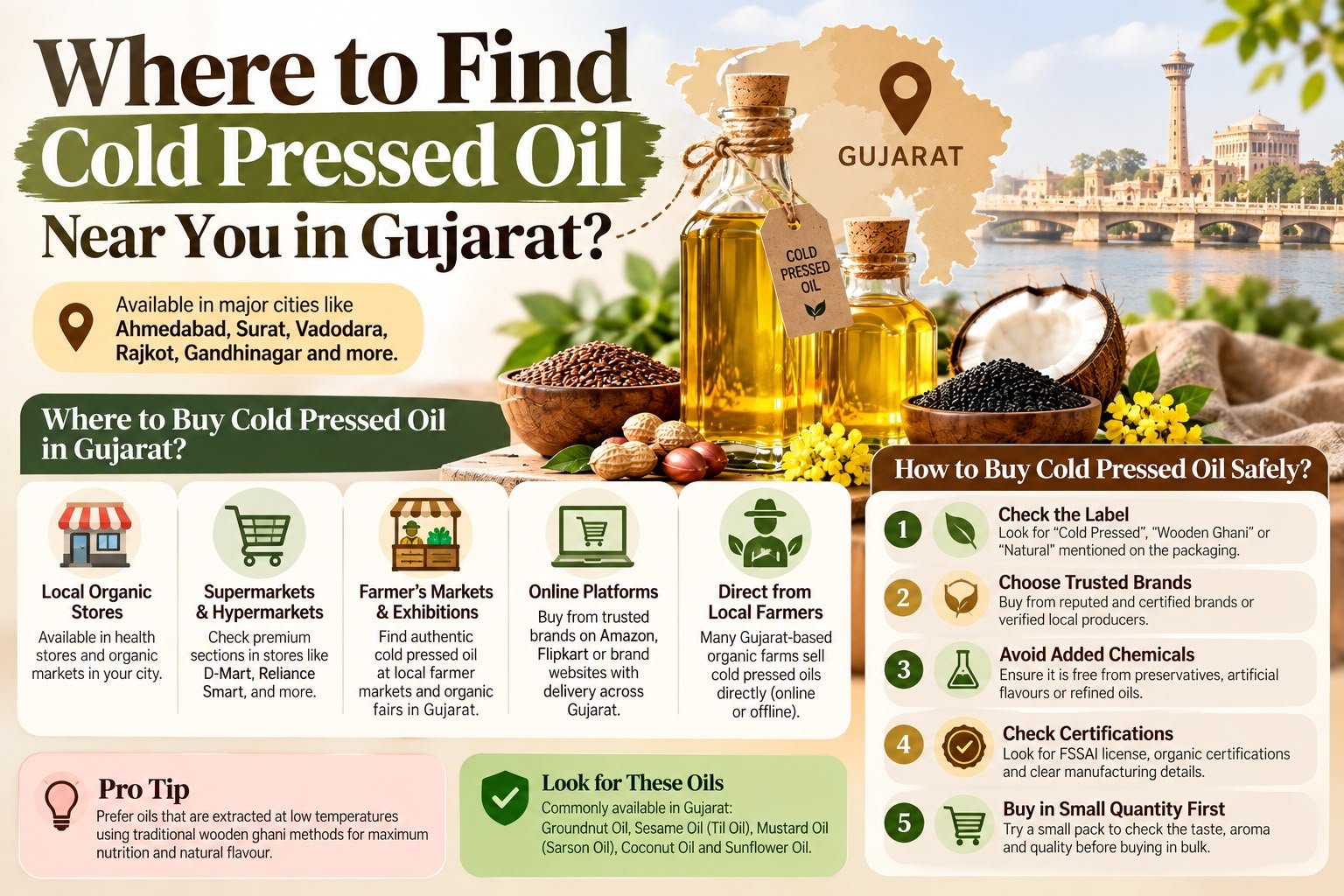
To find cold pressed oil near you in Gujarat, check local kachi ghani units, farmers’ markets and verified online sellers, then confirm the FSSAI licence number, batch date and lab report before buying. If possible, visit the unit and ask to see how the oil is pressed.
Gujarat is one of India’s leading groundnut-growing states, so cold pressed groundnut oil is easy to find in cities such as Ahmedabad, Surat, Vadodara and Rajkot. That easy availability also means buyers of cold pressed oil should compare sellers carefully. Checks do take place: FSSAI has seized around 6,500 kg of ghee it found adulterated in Gujarat, worth roughly ₹35 lakh. That case involved ghee rather than oil, but it shows that edible products in the state are sampled and tested.
A simple routine makes buying safer:
- Search for “cold pressed oil near me” and shortlist two or three sellers.
- Verify each licence number on FSSAI’s FoSCoS portal.
- Ask for the latest batch report.
- Buy a one-litre trial pack and check the smell and taste.
- Reorder only if the quality stays consistent.
If you prefer home delivery, Anveelifecare supplies cold pressed oils and desi ghee, and you can explore our range online.
Frequently Asked Questions About Cold Pressed Oil and FSSAI Rules
Is cold pressed oil the same as kachi ghani oil?
Mostly yes. Both rely on low-heat mechanical pressing without chemical solvents. Kachi ghani is the traditional Indian term for cold pressed oil and is most often used for mustard oil.
Are the 2026 FSSAI changes mandatory?
The revised refractive index values for edible oils took effect on 1 February 2026. The minor seed oil standards were reported as a draft, so check FSSAI’s website for their final status.
Which is the best cold pressed oil for daily cooking?
It depends on your cuisine and taste. Groundnut, mustard, sesame and coconut are common choices, and rotating between them is a healthy habit.
Why is cold pressed oil more expensive?
Low-temperature pressing recovers less oil from each kilo of seed and takes more time, so the cost per litre is higher than for refined oil.
How can I check if my oil is genuine?
Verify the FSSAI licence number, check the batch details, use your sense of smell and taste, and ask the seller for a lab report. Home tricks are not reliable.
Final Thoughts: Choose Cold Pressed Oil With Confidence
The 2026 updates point in one clear direction: stricter purity checks, more honest labels and more accountability for sellers. For buyers of cold pressed oil, this means asking better questions about the licence, the batch and the lab report. For sellers, it means testing regularly, keeping records and staying away from exaggerated claims.
Cold pressed oil is a good option for people who value natural flavour and minimal processing, but it works best as part of a balanced diet and sensible cooking habits. Start with a small trial pack, compare two or three brands and keep your own checklist ready, so you can find the best edible oil in India for your family.
Ready to try pure cold pressed oil, kachi ghani oil, desi ghee or start your own oil business? Explore Anveelifecare’s products and training programs today.
Before publishing
- Replace each (Internal link suggestion…) line with the actual page link, then delete the bracketed note.
- Add an author box and your FSSAI licence number below the blog.
- Run the final text through Duplichecker once more.
